


What tour managers, labels, and artist teams need to know about sourcing merchandise that moves – from production through the merch table.
Merch is no longer a side hustle for artists. From emerging artists playing 500-cap rooms to headliners selling out arenas, merchandise revenue is one of the most consistent income streams in the business. A well-run merch table in a single night can generate more cash than the performance fee. But the gap between merch that sells and merch that sits in a storage unit and on the balance sheet after the tour ends comes down to decisions made long before the first show; in how the product is sourced, how it’s decorated, and how it’s time to arrive.
At Culture Studio, we’ve produced merchandise for concert tours, festival activations, and music label campaigns across every genre. This guide covers what the best buyers in the industry do differently and what first-time merch buyers consistently get wrong.
IN THIS GUIDE:
1 Why merch is a serious revenue line – not an afterthought
2 What actually sells at shows and festivals
3 Decoration methods that work for music merch
4 The production timeline most artists underestimate
5 How to brief your manufacturer for tour merch
6 The most common merch mistakes – and how to avoid them
Section 1
Why Merch Is a Serious Revenue Line – Not an Afterthought
The economics of music have shifted dramatically over the past decade. Touring costs – production crew, travel, venue – have climbed every year. Merch is one of the few parts of the business where the margin is still genuinely good, and where artists and labels have direct control over the product, the pricing, and the experience.
For context: at a 1,000-capacity show with a $30 average merch spend per buyer, a 30% purchase rate generates $9,000 in a single night. Scale that across a 40-date tour and the numbers become significant. Festivals operate on a different model but with the same logic. A well-positioned merch activation at a major festival- the right product, the right placement, the right visual presentation – can move more units in a weekend than a month of online sales. The artists and labels who treat merch as a serious line item, not a box to check, are the ones who build it into the production budget from day one, brief their manufacturer with the same rigor they’d apply to a music video, and think about the merch table the same way they think about stage production.
That’s the mindset this guide is written for.
Section 2
What Actually Sells at Shows and Festivals
Not all merch performs equally. After producing merchandise for the largest tours and festivals, we’ve seen clear patterns in what moves and what doesn’t.

The T-shirt is still the anchor.
Every merch table needs a strong T-shirt. It’s the lowest price point, the easiest impulse buy, and the item most fans will pick up even if they’re not planning to spend. The tees that sell are the ones that feel considered: a heavier blank, a washed or dyed finish, a graphic that works as a standalone piece of clothing rather than solely a promotional item.
Hoodies outperform everything at the right price point.
At festivals especially, a well-made hoodie is usually the highest-margin item on the table. Buyers who hesitate at a $45 tee will spend $85 on a hoodie without thinking twice – because the perceived value is there. The key is that the hoodie has to look and feel premium. A mid-weight fleece with a basic chest print won’t justify that price. A heavyweight garment with mixed decoration – embroidered/chain stitch logo, specialty ink on the back, washed finish – will.
Hats convert fans who aren’t buying anything else.
Structured caps and unstructured dad hats are consistent performers. They’re wearable year-round, they’re visible in a crowd (which is free marketing), and they’re easy to sell at a $35-$45 price point. Chain stitch embroidery on a hat – especially script lettering or a vintage-style logo – creates a product that looks handmade and collectible rather than mass-produced.
Limited items create urgency.
The best merch tables have at least one item marked as limited – a specific colorway, a design exclusive to that show or festival, or a premium piece produced in a small run. Scarcity drives decisions. When a buyer knows they can’t get that item online later, the friction to purchase drops significantly.
Screen printing – the workhorse of tour merch
Screen printing is the standard for high-volume tour and festival merchandise. It’s cost-effective at scale, holds up wash after wash, and handles bold graphics and multi-color designs better than any other method.
All-over screen printing – for artists who want to stand out
All-over printing covers the entire garment – front, back, sleeves, collar – with a continuous graphic. It’s the technique behind the kind of merch that stops people at a table, the piece that looks like it belongs in a streetwear drop rather than a merch bin. For festival activations and limited-run pieces, all-over printing creates visual impact that standard decoration can’t match.
Embroidery – for logos, hats, and premium pieces
Embroidery adds dimension and perceived value that print can’t replicate. A hat with an embroidered logo reads as a finished, retail-quality product. An embroidered chest logo on a heavyweight hoodie elevates the piece into a different price bracket.
Chain stitch – for the piece that becomes a collectible
Chain stitch embroidery is the technique that separates the merch table from a retail experience. The continuous looped stitch creates a raised, textured line that feels handmade – because in a meaningful sense, it is. Script lettering in chain stitch on a jacket or cap reads as crafted, considered, and collectible. It’s what separates a $120 jacket on a merch table from a $45 one.
Culture Studio operates chain stitch machines in-house in Chicago – one of the few manufacturers in the market with this capability at production scale. For artists and labels who want that look, we can produce it.
See our full Decoration Guide for file specs and method-specific requirements.
Section 4
The Production Timeline Most Artists Underestimate
Timeline is where most merch projects break down. Not because manufacturers can’t move fast – but because the upstream steps take longer than buyers expect, and the consequences of missing a show window are absolute.
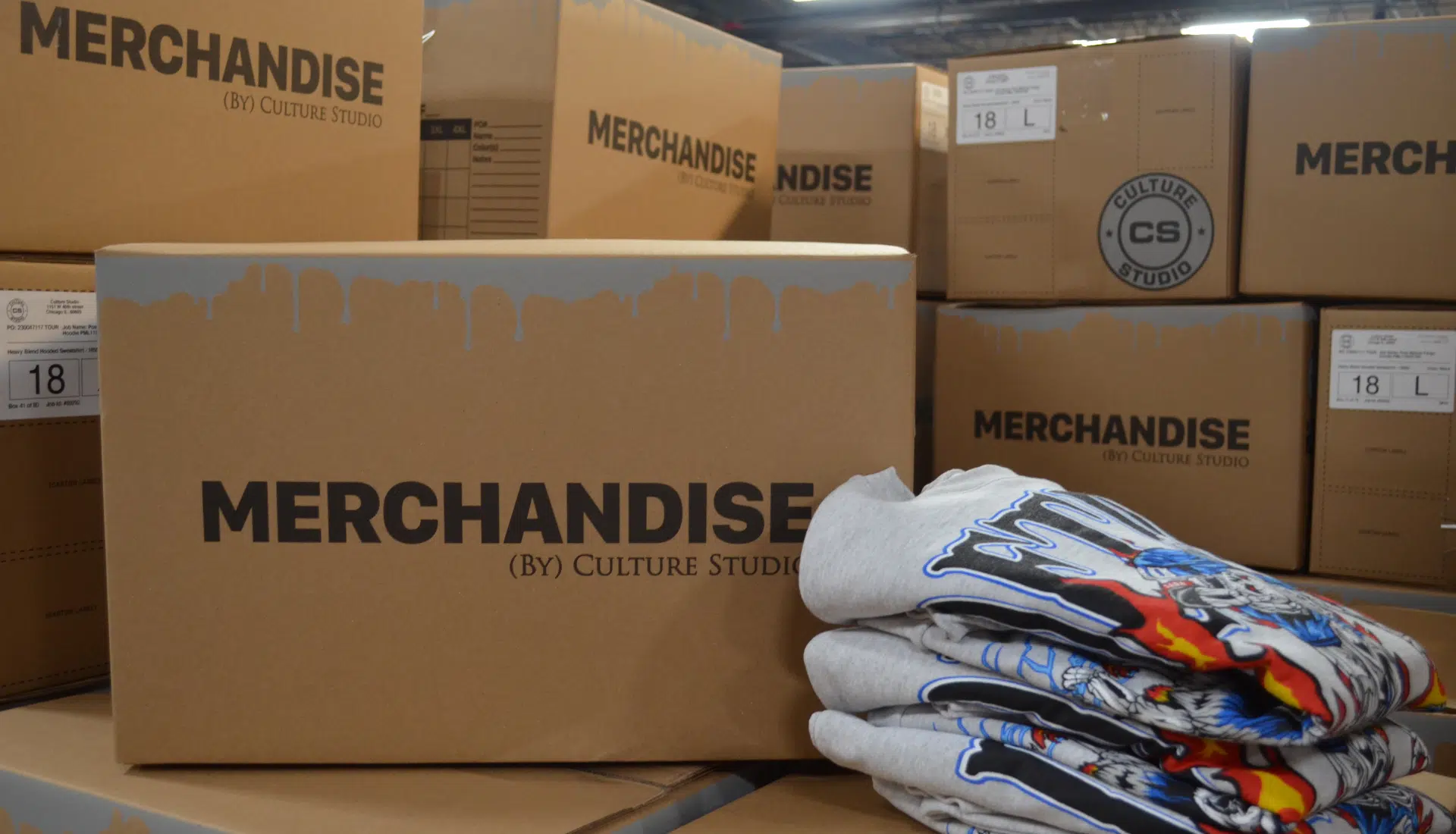
Here’s a realistic production timeline for a standard tour merch run:
Artwork approval: 1-2 days (longer if revisions are needed)
Sampling (if required): 3-5 business days – skip this and you’re gambling on the final product
Production: 5-7 business days for standard runs – longer for mixed decoration or large quantities
Finishing & fulfillment: 1-3 business days for folding, polybag, hangtags, kitting
Shipping to venue or warehouse: 2-5 business days depending on destination
That’s a minimum of 2 weeks from approved artwork to product in hand – and that’s a clean run with no revisions, no sampling delays, and no production issues.
The practical implication: if your first show is on a specific date, count back 4 weeks minimum and that’s when your artwork needs to be approved and your order needs to be placed. Not started – placed and approved.
Rush production is available at Culture Studio.
Section 5
How to Brief Your Manufacturer for Tour or Festival Merch
A complete brief is the difference between a smooth production run and a series of back-and-forth emails that eat your timeline. The more specific your brief, the faster and more accurately your manufacturer can quote and produce.
What your merch brief needs to include:
Artist or tour name and any existing brand guidelines or color restrictions
Product list: styles, colorways, and quantities by size for each item
Decoration method per item: screen print, embroidery, chain stitch, all-over – and placement on the garment
Artwork files: preferred (png, ai, psd, pdf, tiff, etc.,)
In-hands date: when and where product needs to arrive – venue address, festival dock, or warehouse
Finishing requirements: hangtags, size stickers, polybag, folding spec, any private label needs
Budget range: helps your manufacturer recommend the right blanks and methods without guessing
Section 6
The Most Common Merch Mistakes – And How to Avoid Them
These are the patterns we see repeatedly from first-time artists and from experienced teams who’ve been doing this long enough to have formed bad habits.
Starting too late.
The single most common mistake. Teams lock in the tour dates, focus on production and routing, and treat merch as a task to handle closer to the first show. By the time artwork is finalized and the order is placed, there’s no runway for sampling, revisions, or anything going wrong in production. Start your merch brief the same week you confirm tour dates.
Ordering only one product.
A merch table with one item – usually a tee – leaves money on the floor. Fans make purchase decisions based on what they see. A table with a tee, a hoodie, and a hat gives every buyer something in their price range. The incremental cost of adding a second or third SKU is almost always justified by the lift in total revenue per show.
Using the cheapest blank available.
The blank is the foundation of the product. Investing in a premium blank – heavier weight, better hand feel, better drape – changes how the product is perceived and what you can charge for it.
Skipping the sample.
For a first run with a new manufacturer, or for any item with mixed decoration or complex artwork, sampling is not optional. A sample catches color matching issues, placement problems, and print quality concerns before they’re baked into 500 units. The cost of a sample is always less than the cost of a production run that comes back wrong.
Not planning for sell-through after the tour.
Merch doesn’t stop selling when the tour ends. Online sales, fan club exclusives, and back-catalog drops can extend the life of tour product significantly. Build enough inventory to have something to sell after the last show – and brief your manufacturer on packaging and fulfillment requirements if you’re planning to sell direct-to-consumer.
Ready to build your merch program?
Tour merch, festival activations, label campaigns – we’ve done it all. Talk to our team.


