

Everything you need to evaluate, brief, and partner with the right clothing manufacturer before you commit a single dollar.
Finding the right clothing manufacturer is one of the highest-stakes decisions a brand, label, or enterprise buyer makes. The wrong partner costs you time, margin, and in some cases, your reputation with clients. The right one becomes part of how you build.
Whether you’re sourcing concert merchandise for a major tour, building a private label apparel line, or outfitting a corporate team with branded workwear, the evaluation process is more involved than most buyers expect – and more important than most manufacturers tell you.
This guide covers every stage: what to look for before you reach out, how to evaluate a manufacturer’s actual capabilities versus what they claim, how decoration methods affect your final product, and how to structure a brief that gets you an accurate quote the first time. We’ve also included a section on the questions buyers most often forget to ask.
IN THIS GUIDE:
1 What to look for in a manufacturer
2 Decoration methods compared
3 Minimum orders & pricing
4 How to brief a manufacturer
5 Questions most buyers forget to ask
6 Choosing by use case
Section 1
What to look for in a Custom Apparel Manufacturer

1. Decoration range
The best manufacturers can handle full decoration stack – embroidery, all-over screen printing, sublimation, specialty inks, dye & wash, and transfers – under one roof. This matters because most real projects require more than one technique. A jacket might need embroidery on the chest, a screen-printed graphic on the back, and a custom woven label inside. Coordinating three separate vendors for one garment is a logistics nightmare.
2. Scale match
A manufacturer optimized for 100- unit orders will struggle with a 10,000 unit orders. Before investing time in any vendor relationship, confirm that your expected order volume sits comfortably in their operational sweet spot, not at the edge of it.
3. Turnaround infrastructure
For concert and tour merchandise, timing is binary – the product is either there for the show or it isn’t. Ask for specific turnaround windows by decoration type, not marketing language like “fast turnaround”. Get a production calendar in writing.
Section 2
Decoration Methods Compared – And How to Choose
The decoration method determines how your design looks, how it ages on the garment, what it costs to produce, and how complex your artwork brief needs to be. Most buyers underestimate how significantly the wrong method choice affects the final product.
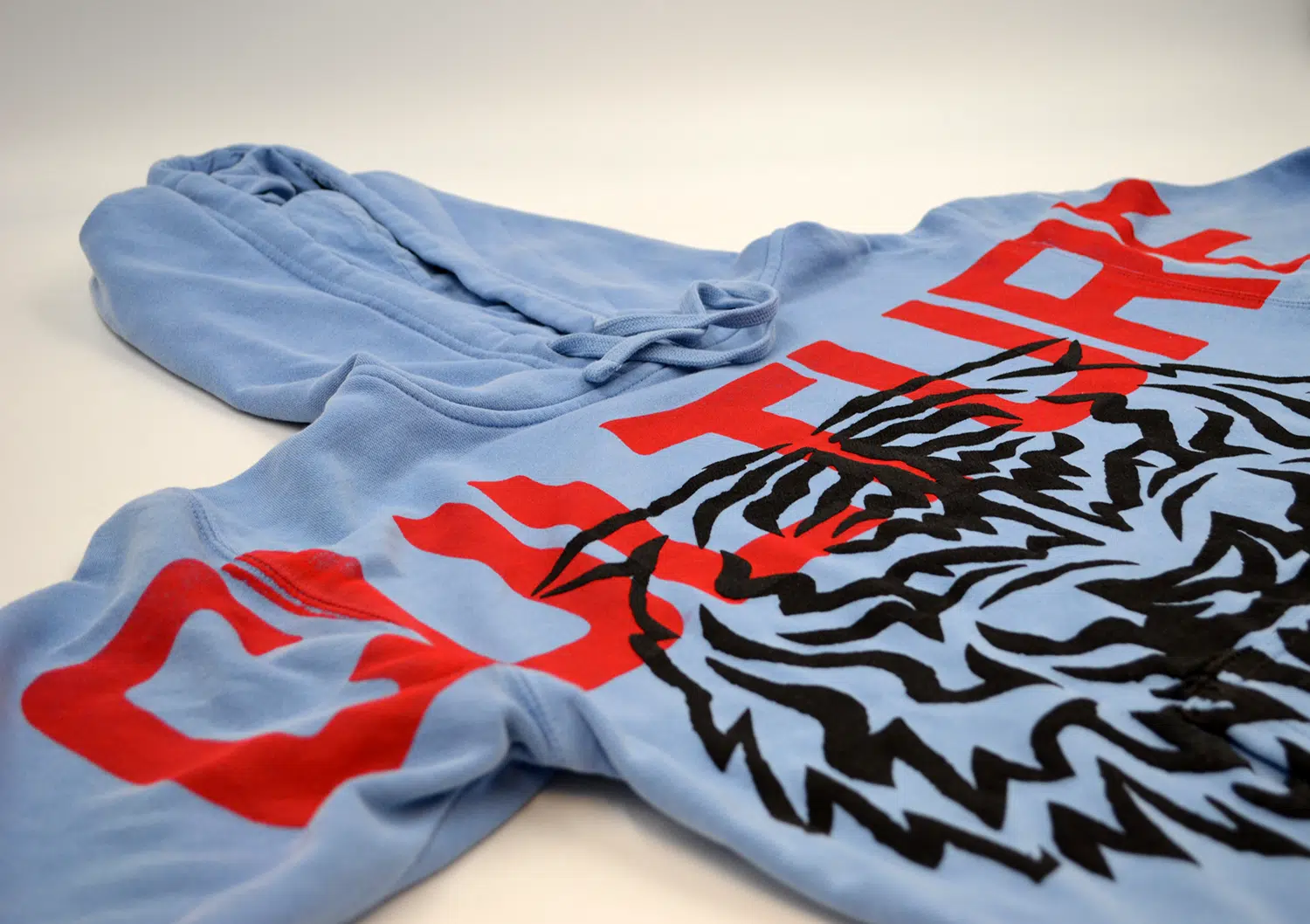

The method most buyers get wrong
Buyers sourcing concert and festival merchandise often default to just one design process – which will still create an amazing product that will have good demand. However, the best tour merch combines methods: screen-printed body graphics with embroidered detailing or chain stitch lettering to create a layered, premium finish that justifies a higher retail price point and result in the best end product that fans will love.
Similarly, buyers building corporate uniform programs usually don’t know what method their logo best translates to – intricate logos with thin linework and gradients frequently lose detail in certain design types; requiring artwork simplification before production.
See our full Decoration Guide for file specs and method-specific artwork requirements.
Section 3
Minimum Orders, Pricing Structure & What Affects Your Quote
Apparel manufacturing pricing is less standardized than most buyers expect. Two quotes for “500 screen-printed T-shirts” from two different vendors can vary by 40-60% and both can be accurate, depending on what’s actually included.
Understanding the variables that drive price prevents surprises and lets your compare quotes on equal terms.
What goes into a manufacturing quote:
- Garment cost: Blank cost varies by brand, weight, and composition. A premium heavyweight blank can cost 2-3x a standard cotton tee.
- Setup/screen fees: Screen printing requires a separate screen for each color. Setup fees per screen are standard – factor these into cost-per-unit for small runs.
- Decoration complexity: More colors, larger print areas, and mixed techniques (embroidery chain stitch + print on the same garment ) all add cost.
- Quantity breaks: Most manufacturers have tiered pricing – cost per unit drops meaningfully.
- Fulfillment & logistics: Does the quote include individual polybag packaging, hand tags, folding, kitting, or direct-to-consumer shipping? These are often listed as line items or excluded entirely.
- Rush production: Expedited timelines typically carry a 15-35% surcharge depending on the manufacturer’s capability.
Private label & blank wholesale pricing
Brands building a private label line have a different pricing structure than buyers sourcing decorated garments. Wholesale blank pricing depends on style, weight, and volume commitment. Culture Studio’s C100 private label blank program is designed for brands that need a manufacturer – quality canvas – not a commodity blank – as the foundation of their product line.
Section 4
How to Brief a Custom Apparel Manufacturer (and Get an Accurate Quote Fast)
The single biggest source of delays, miscommunication, and quote revisions in apparel manufacturing is an incomplete brief. A manufacturer can’t give you an accurate quote within a timely manner – or produce what you actually want – without specific information upfront. The more detailed your brief, the faster the process moves.

YOUR MANUFACTURING BRIEF CHECKLIST
Garment style(s): T-shirt, hoodie, hat, jacket – and any specific blank brands or styles if you have a preference
Quantity by size: Total units and size run (S/M/L/XL/2XL breakdown)
Decoration method: Screen print, embroidery, sublimation, cut & sew, or mixed – and where on the garment
Color count: How many ink or thread colors per decoration location
Artwork files: Vector files (png, ai, psd, pdf, tiff, etc.) – or indicate you need digitizing
In-hands date: When the finished product needs to be at its destination — not when you want to place the order
Ship-to destination: One location or distributed fulfillment to multiple addresses
Finishing requirements: Hangtags, polybag, size stickers, wraps, woven labels, etc.
Review our full Artwork Guidelines before submitting files – incorrect file formats are the most common reason quotes stall. For complex projects or new clients, our team offers a brief review call before production begins.
Section 5
Questions Most Buyers Forget to Ask
After +18 years working with brands, labels, agencies, and enterprise buyers, these are the questions that consistently separate satisfied long-term clients from buyers who have a difficult first experience.
“What happens if the first sample isn’t right?”
Every manufacturer’s samples process is different. Understand upfront: How many round of revision are included? Is there a cost for samples? Who owns the sample inventory? A manufacturer who can’t answer this clearly hasn’t thought through their client experience.
“Who is my point of contact form brief through delivery?”
Account fragmentation – sales, production, and shipping each handled by a different persons with minimum shared context – is one of the most frustrating experiences in manufacturing. Ask explicitly whether you’ll have a single account manager or be handed off between departments.
“What’s your current production capacity and lead time?”
Manufacturer’s lead times fluctuate with their order volume. A vendor that quotes 10-day turnaround during a slow period may be running 2-4 weeks during peak. Ask what the current standard lead time is. For tour and concert merchandise, this is a non-negotiable question.

“Do you handle fulfillment and logistics, or just manufacturing?”
Full-service manufacturers offer finishing and fulfillment – polybag, kitting, inventory holds, and direct-to-consumer or venue shipping. If you need this, confirm it’s a native capability.
Section 6
Choosing a Manufacturer by Use Case
Different project types have different critical requirements. Here’s how to prioritize when evaluating vendors for each major use case.
Concert & Festival merchandise
For music and entertainment clients, the non-negotiable are: confirmed in-hands date reliability, all-over printing capability, mixed decoration in a single production run, and fulfillment to multiple venue locations. Turnaround time matters more than cost-per-unit. A missed show window cannot be recovered.

Corporate & branded workwear
Corporate uniform programs and branded workwear require consistent color matching across multiple decoration runs, size inclusivity across the range, and often mixed decoration – embroidered logo on chest, woven label inside, printed hangtag. Reliability and repeat-order consistency matter more than novelty.
Private label clothing brands
Brands building a private label line need a manufacturer who understands brand positioning, not just production specs. The blank quality, finishing, label placement, and packaging are as important as the decoration. Look for manufacturers with an existing private label program – the infrastructure is already built.
Promotional product campaigns
Enterprise buyers sourcing promotional merchandise at scale – for events, trade shows, onboarding kits, or client gifting – need a manufacturer with high-volume screen printing capability, consistent per-unit pricing at scale, and the ability to handle kitting and drop-ship. Individual customization (names, departments) adds complexity; confirm the vendor has handled personalization at volume before committing.

Choosing the right apparel manufacturer isn’t just about price – it’s about finding a partner who can execute your vision, meet your timelines, and deliver consistent quality at scale. The more clarity you bring into the process – from decoration method to production requirements – the better your outcome will be.
If you’re planning a project and want expert guidance before you commit, our team can help you evaluate the right approach, refine your brief, and move forward with confidence.
Ready to start your project?
Concert merch, corporate apparel, or private label – we respond within one business day.